
On this page
How much does a small business website cost? As of October 2026, about $200–$350 for the first year if you build it yourself on a website builder, and from about $4,300 if a professional builds a 5–10 page site at our $3,500 starting price, once hosting, a domain and maintenance are added. With us, custom sites and redesigns cost $8,000–$25,000 to build, and online stores start at $15,000 plus platform and payment fees.
The build is only part of it. A website also has a yearly bill for the domain, hosting or a builder plan, email, maintenance and, if you sell online, a fee on every order.
Below are plan prices we checked on vendors' own pricing pages in October 2026, our own price ranges (labeled as ours, since other firms price differently), what moves a quote, three worked budgets and the contract terms that are hardest to fix later. We build websites, and we'll say plainly where a builder plan is the better buy.
How much does a small business website cost in year one?
Here's each route's first-year cost: the build plus a year of running costs. Email is left out because it costs the same on every route, about $84 per person per year.
| Route | Build | Running costs, year one | First-year total |
|---|---|---|---|
| DIY on a website builder | $0, plus your time | About $204–$348 for the plan, billed yearly | About $200–$350 |
| Freelancer | Quote-based; varies widely | Hosting or plan, domain and upkeep | Your quote plus running costs |
| Small business site, 5–10 pages (our pricing) | From $3,500 | From about $780 | From about $4,300 |
| Custom site or redesign, 15–40 pages (our pricing) | $8,000–$25,000 | About $1,450–$6,210 | About $9,500–$31,200 |
| Online store (our pricing) | From $15,000 | From about $2,600, plus payment fees | From about $17,600, plus payment fees |
For the professional routes, running costs assume hosting at $20–$100 a month (the typical range for a business website), a .com domain at $11 a year and maintenance at 15–20% of the build cost per year, the budgeting rule we use. The store row uses Shopify Basic at $29 a month, billed yearly.
DIY on a website builder
Builder plans include hosting and an SSL certificate, and the vendor keeps the platform updated. As of October 2026:
- Wix: paid plans start at about $17 a month on a yearly subscription paid up front; Wix notes that prices vary by location. Its Light plan can't take payments; Core is the first plan that can.
- Squarespace: Basic is $19 a month billed annually ($25 month to month), with a 2% transaction fee on store sales. Core is $29 ($39 month to month), drops the store transaction fee to 0% and includes one Google Workspace email account free for the first year.
- Shopify: Basic is $29 a month billed yearly ($39 monthly), and online card payments through Shopify Payments cost 2.9% + 30¢.
Annual Squarespace plans, and most first-time annual Wix plans, include a free domain for the first year. What no plan includes is the work: choosing a template, writing every page, finding photos and setting up forms, search basics and analytics yourself.
Freelancers
We don't publish a freelancer range because there isn't an honest one. Quotes run from a quick template setup to senior specialists who price like small studios, and "five-page website" can describe very different jobs. Compare freelancers on one written scope instead, and ask who handles updates and fixes after launch.
Professional builds (our pricing)
Our small business sites include mobile-first design, a content management system, contact forms, on-page SEO and analytics, and typically launch in 3–5 weeks. Custom sites and redesigns add a custom design system, integrations, content migration and redirects, and take 5–10 weeks. Online stores and complex sites take 6–12 weeks. These are typical ranges, not quotes; our website design service page shows what each includes.
What drives the price of a website
A quote is mostly hours. These are the things that create them.
Page types, not just page count
Pricing follows the number of distinct layouts more than the number of pages. Eight pages that share three templates (home, service, contact) cost less to design than eight one-off layouts, and 20 service-area pages on an existing template are mostly writing time.
Copywriting and photos
The site can't launch until every page has words. Writing them yourself saves money and costs time; a good copywriter costs more and writes each service page around what buyers search for. Real photos of your team, vehicles and finished jobs beat stock images on a local business site.
Template or custom design
A good template adapted to your brand is the fastest and cheapest route, and the right call for most small sites. Custom design earns its cost when you need to stand apart in a crowded market, your brand already has a defined look, or the site needs layouts no template handles well.
Features and integrations
Each feature adds design, build and testing time, and some add a subscription:
- Booking. Embedding a scheduling tool is cheap: Calendly's free plan covers one event type, and its paid plans add payment collection through Stripe or PayPal. A custom booking flow tied to staff calendars is a bigger job.
- Forms into your CRM. A form that emails the office is simple; one that creates a lead in your CRM needs an add-on or an integration. Gravity Forms includes a HubSpot add-on in its $59-a-year Basic license, but its Zapier and Stripe add-ons start on Pro at $159 a year. Our CRM integration guide compares the routes.
- Payments. A deposit or "pay your invoice" page through Stripe costs 2.9% + 30¢ per domestic card payment, on top of the build.
- Online store. Cost grows with the catalog: products, variants, shipping and tax rules, and product data to migrate.
- More than one language. Every language is another copy of every page to write, review and keep current.
- Logins and dashboards. Customer accounts, portals and dashboards turn a website into a web app, which is priced as software rather than as a website; our web app cost breakdown shows what drives that price.
Accessibility
The Justice Department's position is that the ADA covers what businesses open to the public offer on the web, and it points to the WCAG guidelines as technical guidance. Designing accessible colors, focus states and form labels from the start is cheaper than retrofitting every template later. Our guide to ADA-compliant websites covers the checklist and how to test; this is general information, not legal advice.
SEO and analytics setup
Page titles, descriptions, headings, structured data, image alt text, speed work and a sitemap belong in the build. So do Google's free tools (Analytics, Search Console and your Business Profile) and conversion tracking that shows which pages produce calls and form leads. Ongoing SEO and AI search optimization, the slow work of earning rankings and mentions in AI answers, are monthly services and shouldn't hide inside a build price.
Moving from an old site
A redesign adds an inventory of every existing URL, content to carry over and redirects; our website redesign guide has the full process and an SEO checklist. Google recommends permanent server-side redirects (301 or 308) from each old URL to its new address, kept for at least a year. Leaving a builder usually means a rebuild: a Wix site has to run on Wix's servers, and Squarespace exports only some content as a WordPress import file, without store pages, style settings or custom CSS. Before a redesign, a free website audit shows what already ranks and what's broken.
Website maintenance cost and other yearly costs
Once the site is live, these are the bills, at list prices as of October 2026:
| Cost | Typical per year | What to know |
|---|---|---|
| Domain (.com) | About $11–$19 | Porkbun lists $11.08 a year. Namecheap renews at $18.48 plus a $0.20 ICANN fee. Annual Squarespace and most annual Wix plans include year one. |
| Hosting or builder plan | About $240–$1,200 | Business website hosting typically runs $20–$100 a month. Builder plans include hosting: Squarespace is $19–$99 a month, billed annually. |
| SSL certificate | $0 | Let's Encrypt issues trusted certificates at no cost, and builders and most hosts include one. |
| Business email | $84 per person | Google Workspace Business Starter is $7 per user per month with a 1-year commitment ($8.40 flexible). Microsoft 365 Business Basic is $7 per user per month, paid yearly. |
| Maintenance and updates | 15–20% of the build cost | Our budgeting rule for software and plugin updates, backups, security monitoring and fixes. On a builder, the platform handles software updates. |
| Plugin, theme and app licenses | $0 to a few hundred | Premium WordPress plugins usually renew yearly. Paid Shopify themes are licensed to one store and are a final sale. |
| Content updates | Your time, or paid work | New services, photos, staff bios and posts. |
| Analytics, Search Console, Business Profile | $0 | Google's tools are free. |
WordPress itself is free, open-source software, so a WordPress site's yearly costs are hosting, licenses and someone's time. Three things catch owners out:
- Introductory prices. Hosting and domains are often discounted for the first term. SiteGround's StartUp plan is $2.99 a month for the first 12 months, prepaid, then renews at $17.99 a month. Namecheap's first-year sale price for a .com is $11.28, against an $18.48 renewal. Budget on the renewal price.
- Paying for SSL. If a quote or hosting bundle includes a paid certificate, ask what it adds over the free one your host or builder already provides.
- Maintenance nobody owns. A WordPress site needs core, theme and plugin updates, backups and someone watching for problems. Decide up front whether that's you, a developer on a care plan (we offer optional ones) or your host.
Three example budgets
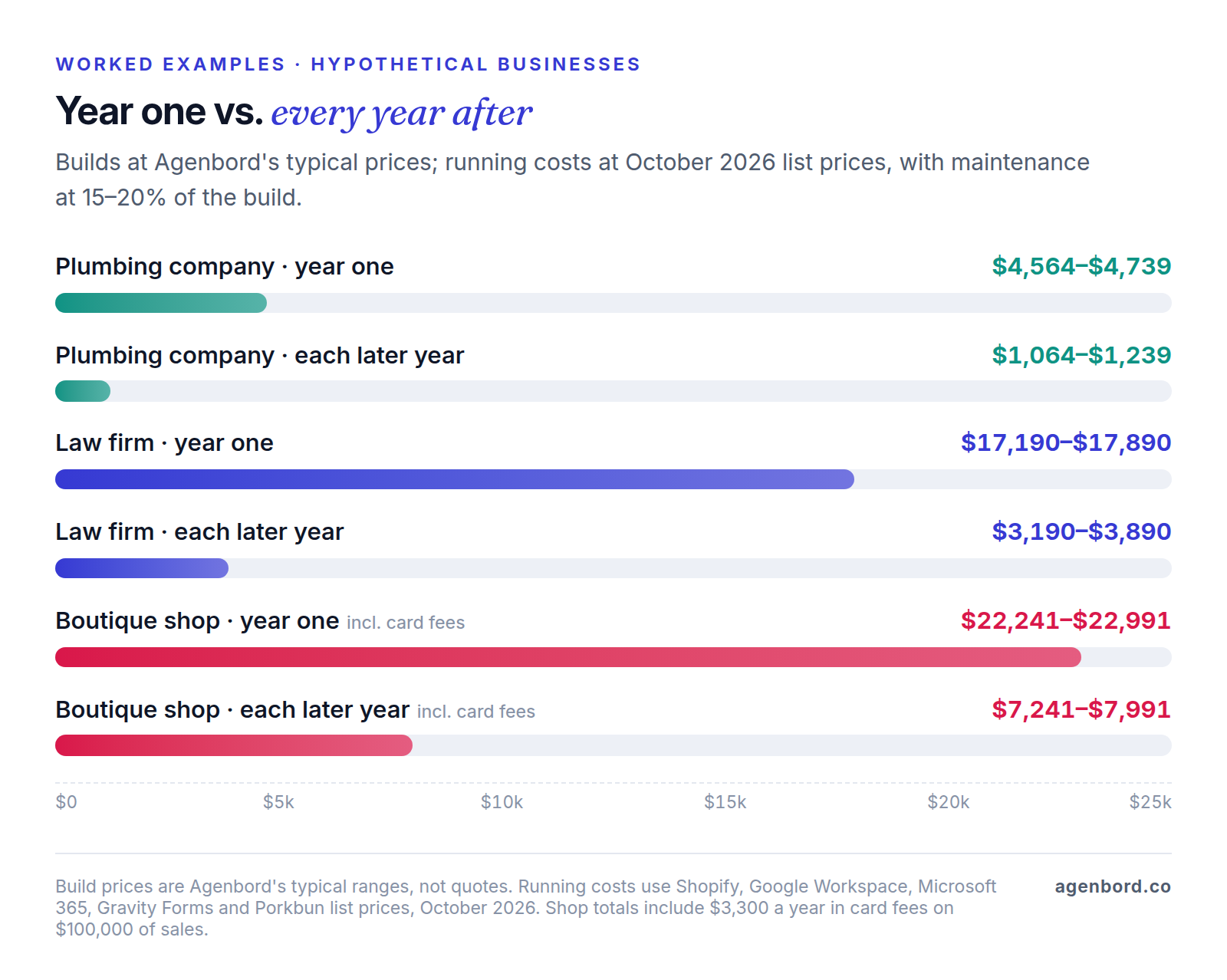
These businesses are hypothetical. Build prices use our typical ranges; running costs use the October 2026 list prices above, a .com domain at $11 a year (rounded) and maintenance at 15–20% of the build.
A two-truck plumbing company: small business site
Eight pages on WordPress (home, four service pages, a service-area page, about and contact), with tap-to-call buttons and a quote form that emails the office. The owner supplies photos and notes on each service.
| Item | Year one | Each later year |
|---|---|---|
| Build (our small business tier) | $3,500 | $0 |
| Hosting at $30 a month | $360 | $360 |
| Domain | $11 | $11 |
| Email, 2 users (Google Workspace Business Starter) | $168 | $168 |
| Maintenance, 15–20% of the build | $525–$700 | $525–$700 |
| Total | $4,564–$4,739 | $1,064–$1,239 |
Built by the owner on Squarespace Core, the same eight pages would cost $432 in year one ($348 for the plan, which includes one email account, plus $84 for the second) and the owner's evenings. If most work arrives through referrals and the Google Business Profile, that's a sensible start. If the website is where new customers find you, the build buys service pages edited for what people search and tracking that shows which pages bring calls.
A small law firm: redesign with online intake
Three attorneys and two staff replacing a dated site: about 20 pages (six practice areas, three attorney bios, existing articles carried over), a custom design, a consultation form that sends each enquiry to the firm's HubSpot CRM, the scheduling tool the firm already uses, accessibility testing and redirects for every old URL.
| Item | Year one | Each later year |
|---|---|---|
| Build (our custom site or redesign tier) | $14,000 | $0 |
| Hosting at $50 a month | $600 | $600 |
| Domain | $11 | $11 |
| Email, 5 users (Microsoft 365 Business Basic) | $420 | $420 |
| Forms plugin with HubSpot add-on (Gravity Forms Basic) | $59 | $59 |
| Maintenance, 15–20% of the build | $2,100–$2,800 | $2,100–$2,800 |
| Total | $17,190–$17,890 | $3,190–$3,890 |
Most of year one is the build, which pays for what a template can't do here: the custom design, the intake integration, the redirects and accessibility testing. If clients also need to log in to share documents or check on their matter, that's a client portal and a separate project; our client portal guide covers when to buy one and when to build.
A boutique online shop: Shopify store
About 150 products, the owner plus two part-time staff who need their own logins, and $100,000 a year in online card sales at an average order of $50. Shopify Basic includes no staff accounts, so the shop needs Grow, which includes up to five.
| Item | Year one | Each later year |
|---|---|---|
| Build (our e-commerce tier) | $15,000 | $0 |
| Shopify Grow, billed yearly at $79 a month | $948 | $948 |
| Domain | $11 | $11 |
| Email, 3 users (Google Workspace Business Starter) | $252 | $252 |
| Apps, assumed at $40 a month | $480 | $480 |
| Maintenance, 15–20% of the build | $2,250–$3,000 | $2,250–$3,000 |
| Subtotal | $18,941–$19,691 | $3,941–$4,691 |
| Card fees: 2,000 orders at 2.7% + 30¢ | $3,300 | $3,300 |
| Total | $22,241–$22,991 | $7,241–$7,991 |
Card fees are the biggest yearly cost after the build, and they grow with sales. On Basic, the same sales would cost $3,500 in fees, $200 more, but the plan costs $600 less a year: Grow's lower rate only covers its higher price from $300,000 a year in online card sales. Here, the staff logins are the reason to pick Grow. A shop still testing demand can start on Basic with one of Shopify's free themes for $348 a year plus fees, and pay for a custom build once sales justify it.
DIY, freelancer or agency: how much should you spend?
How much should a website cost for a small business? Enough for the job the site does in your business, and no more.
DIY is the right call when:
- Most work comes from referrals, repeat customers or your Google Business Profile, and the site mainly confirms you're real.
- You need a handful of pages, a contact form and maybe a booking link.
- You're testing a new business or service and don't yet know what customers will ask.
- You can write, and you have the time to keep the site current.
Paying a professional pays off when:
- The website is your main source of new customers. Compare the first-year cost with the profit on the extra jobs it would need to win.
- The site has to connect to other systems: a CRM, booking, payments or inventory.
- You're replacing a site that already ranks, so redirects and content migration matter.
- You need accessibility testing, several locations or languages, or a catalog of more than a few dozen products.
- Your hours are worth more running the business than learning a builder.
Freelancer or agency? A freelancer suits a well-defined, template-based site, if you find one with relevant examples and a plan for support after launch. An agency costs more but puts design, development, content and SEO under one written scope and doesn't depend on one person's availability. Judge both on the same things: the scope, what you'll own at the end and what happens after launch. Starting on a builder and upgrading later is a reasonable path too, as long as you expect a rebuild and keep your content in documents you control.
Red flags in website quotes and contracts
The most expensive website problems are written into the contract, not the design. Watch for these:
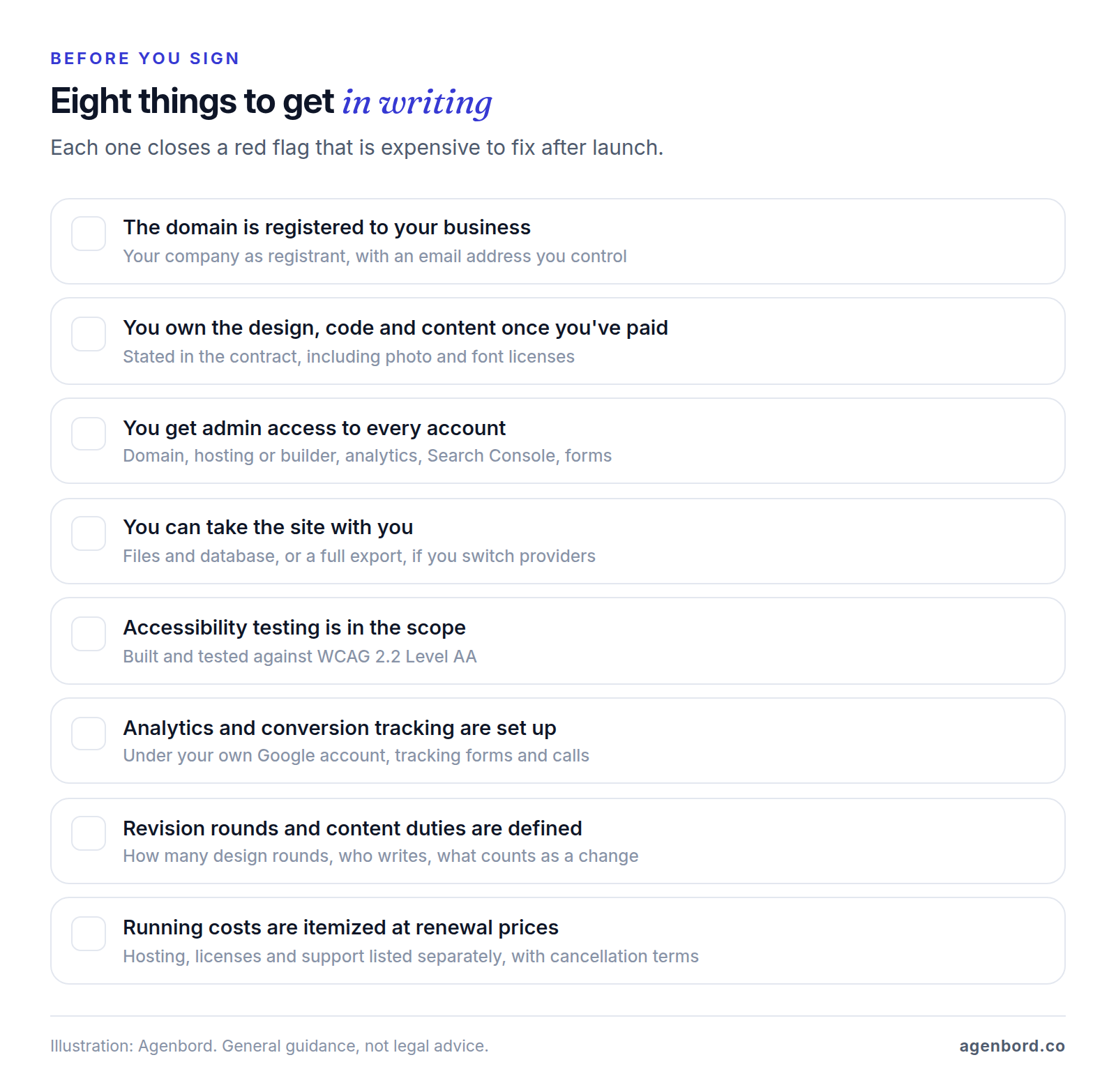
- You don't own the domain. If a designer registers it in their name or account, they control your web address and email. Register it to your business with an email address you control, and give your developer access instead. ICANN expects registrants to keep contact details accurate and to answer registrar inquiries within 15 days, which is hard to do through someone else's inbox.
- You don't own the site. The contract should say who owns the design, code and content once you've paid. Be wary of a "free website" bundled into a long monthly contract, and ask what happens to the site if you cancel.
- Hosting you can't move. A proprietary content system or hosting only the agency controls makes leaving expensive. Ask whether you'll get the files and database, or a full export.
- No accessibility work. If a quote doesn't mention accessibility testing, assume none is included.
- No analytics or conversion tracking. Without them you can't tell whether the site produces leads. Analytics and Search Console should be set up under your business's own Google account.
- Unclear revision limits. "Unlimited revisions" and "a few rounds" both end in arguments. The quote should say how many design rounds are included and what counts as a change request.
- One unexplained monthly fee. A single charge for "hosting and maintenance" is hard to compare or leave. Ask for hosting, licenses and support itemized, at renewal prices.
How to get an accurate website quote
Quotes are only comparable when every bidder prices the same scope. Before you contact anyone, write these down on a page or two:
- The site's job. What counts as a lead (a call, form, booking or sale) and roughly how many you want.
- A page list grouped by type. Home, services, locations, about, contact, blog, and which pages exist today.
- Who supplies content. Which pages you'll write, which you want written and where the photos will come from.
- Features and integrations. Booking, forms into a CRM, payments, a store or extra languages, with the names of the tools you already use.
- Your current site. The address, admin and analytics access, and the pages that bring in traffic or leads.
- Two or three sites you like, and what you like about each.
- Budget range and deadline, and who will update the site after launch.
Then ask every bidder for a fixed price broken down by phase (design, build, content, migration, integrations, testing, training), a launch date and written answers to the eight points in the checklist above.
To set a budget before you ask, use our free small business website cost calculator. Choose a project type (landing page, business website, online store or web app), set the number of pages and switch on the features you need: blog, booking, payments, custom design, SEO setup, copywriting, multilingual, or CRM and API integrations. It gives you a range, not a quote. If you send us your selections, we'll reply with a detailed fixed quote within one business day.
Sources
- Squarespace - Pricing (accessed October 2026)
- Wix - Plans and pricing (accessed October 2026)
- Shopify - Pricing (accessed October 2026)
- Shopify Help Center - Maximum users for each plan (accessed October 2026)
- Shopify Help Center - Adding themes (free and paid themes) (accessed October 2026)
- Wix Help Center - About SSL and HTTPS (accessed October 2026)
- Squarespace Help Center - Squarespace and SSL (accessed October 2026)
- Stripe - Pricing (accessed October 2026)
- Google Workspace - Business plans and pricing (accessed October 2026)
- Microsoft - Compare all Microsoft 365 business plans (accessed October 2026)
- Porkbun - .com domain pricing (accessed October 2026)
- Namecheap - .com domain registration and renewal pricing (accessed October 2026)
- ICANN - Registrants' benefits and responsibilities (accessed October 2026)
- Let's Encrypt - About (accessed October 2026)
- SiteGround - WordPress hosting plans (accessed October 2026)
- Gravity Forms - Pricing (accessed October 2026)
- Calendly - Pricing (accessed October 2026)
- WordPress.org - About WordPress (accessed October 2026)
- Wix Help Center - Exporting or embedding your Wix site elsewhere (accessed October 2026)
- Squarespace Help Center - Exporting your site (accessed October 2026)
- Google Search Central - Site moves with URL changes (accessed October 2026)
- Google Search Console Help - About Search Console (accessed October 2026)
- Google Marketing Platform - Google Analytics (accessed October 2026)
- Google - Business Profile (accessed October 2026)
- U.S. Department of Justice, ADA.gov - Guidance on Web Accessibility and the ADA (accessed October 2026)
- W3C - Web Content Accessibility Guidelines (WCAG) 2.2 (accessed October 2026)
Prices, plans and regulations change. Figures were checked on October 2, 2026; follow the links for the latest. Nothing here is legal, tax or financial advice.
About the author
Founder, Agenbord
Muhammad Hamza is the founder of Agenbord, the Fort Lauderdale software company behind the construction ERP Smart Construction and a WhatsApp-first billing platform. He writes practical guides on buying, building and automating business software.